Author Archives: Suraj Sood

ਅਣਜਾਣ's avatar

About Suraj Sood

https://docs.google.com/document/d/1AHXJ_oRZoKHgkqY8Tmso-rU-7S-N9_i3k7CPEiYh23Q/edit?usp=sharing aham manovignyanasya ph.d. yah bruhat svapnam pashyati! mam anyebhyah samajikamadhyamaprofilebhyah mam vishaye adhikam sangrahitum shakyate.

The existentialism of Yu-Gi-Oh!

Meaning – Friendship is inherently meaningful: it is worth laying one’s life on the line, and fighting, for.

Death – Individuals can be sent to the Shadow Realm, usually after losing a Duel. In the original dub, these players are killed (reversibly).

Anxiety – Any Duel can be marked by increased anxiety. The higher the stakes, the greater the anxiety!

Isolation – Players who are sent to the Shadow Realm must try to learn how to live by themselves, usually in a state of never-ending torture…rarely, the heroic protagonist must fight the final boss for himself*!

Freedom – Duelists fight to free their friends–and, ultimately, the world–from the Shadow Realm.

*Perhaps someday, herself?

Pokémon and Shakespeare

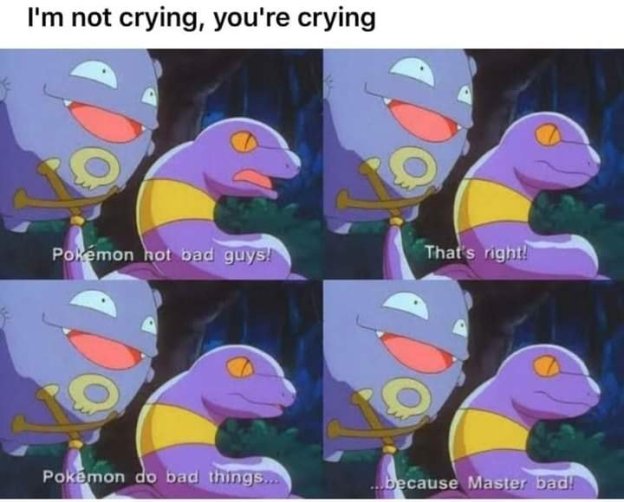
Shakespeare wrote in Hamlet (Act II, Scene II): “…there is nothing either good or bad, but thinking makes it so”. Centuries later, the creators of the Pokémon: Indigo League anime series made an episode titled, “Island of the Giant Pokémon”. In this, Team Rocket’s Pokémon Ekans and Koffing defend their actions against Ash Ketchum’s partners, claiming that they are not bad–rather, their human trainers are.

These two scenes, despite being from distinct media and stories, are related. Both deal with morality, without explicit use of the term “evil”. Hamlet says to Rosencrantz that morality is merely relative to a given observer’s subjective perception and interpretation. Team Rocket’s Pokémon have a somewhat distinct take: they state that good and evil are determined by particular kinds of beings, i.e., authoritative humans.

It is we who have the power to attach ethical valence to actions (or even things, e.g. the atomic bomb); yet we also are characterized by said valences, ourselves. To quote Rafael from the Yu-Gi-Oh! Season 4 dub, speaking to the Pharaoh of Yugi’s Millennium Puzzle: “Are you good? Or, are you evil?” This becomes the question for each of us to wrestle with.

The “good” self-actualizing environmentalist

What makes a good self-actualizing environmentalist? For Robert Hartman the axiologist, a good X fulfills its concept’s definition. A good self-actualizing environmentalist has attended sufficiently to their lower four need types–physiological, safety, love, and esteem (probably, but not necessarily, in this order). Further, they self-actualize in the 13 ways outlined by Maslow in being creative, spontaneous, humorous, etc.

Continental gobbledygook!

“Man is a useless passion” is what Nietzsche’s Superman idea boils down to, and the meaning here ought not to be misunderstood. There can be no greater absurdity than the annihilation of inherent, objective meaning in life, other than to negate the value we place on our selves. Once the latter is done, there is no ideal worth striving for–and so, no life really worth living.

An ideal that would even dare to be so hollow as to be attainable is no real ideal. This is laughably reflective of the all-too-familiar tendency we have to think happiness–happiness in its most basic form!–is something we hope to finally reach. And to place the fool’s foot one step past this inconsistent nonsense, to physically touch an ideal? This is the end of one non-truth and the beginning of the most self-destructive project: the negation of any existential truth, whatever.

Man is a useless passion, and I hold out hope that he’ll stay that way. He is free when he realizes and affirms it!

Walking the middle way of acceptance

At the end of his TEDx Talk, speaker Dylan Woon presents two possibilities following acceptance. These routes are:

1. Live peacefully with the situation

2. Strive actively to change things

Might there be a third, hidden middle route to walk between these two paths? Perhaps one must shift back-and-forth between these options until the new situation solidifies. Whatever mode of existence one has decided on at this point may be the middle way of the accepted reality.

ਪੜ੍ਹਨਾ ਜਾਰੀ ਰੱਖੋ

Balancing power and potential

Potential is the possibility of success. It lies latent, letting us know that we have a chance to succeed someday. How does potential relate to power?

Power and potential can be either rivals or allies. These must be balanced in order to achieve victory and defeat evil.

At any point, potential is the precursor to success. While it does not guarantee victory, it is requisite for such. Power necessitates responsibility, which then gives way to meaning.

Perhaps potential occurs when we gain knowledge of our possibilities for becoming! Then, we must pursue power through the cultivation of skills necessary for reaching our goal. We also need strength to endure tough challenges.

Potential is born from the desire to follow our dreams!

Can we have a science of ourselves?

This question is tantamount to asking whether we can possess knowledge of ourselves. That we can to some extent is trivial, despite the endeavor’s hurdles (many of which–ironically–the human study of psychology has revealed).

We have developed such successful sciences of physics and chemistry due perhaps to our advantage over their subject matter. This is that we have at least a greater degree of consciousness than do particles, waves, and elements.

It may be argued that human scientists have a greater consciousness of people than the average person does. If this is so, then the epistemology of social science is on somewhat comparable grounds to that of physics and chemistry.

However, it is quite probable that human scientists are not so different from laypeople as all people are from physical objects. This represents an asymmetry worth pausing on in answering this post’s question.


SpongeBob and phenomenology

When SpongeBob tries explaining “fun” to Plankton, he finds that the only way he can is to sing a song about it.

Some experiences are so fundamental for some of us that conveying them to others linguistically can be tricky.

The trick in these cases is to “live out” the experience in question. This lets the other know what it is like, and how they can experience it.

Of course–spelling a concept out and defining it more elaborately can work, too! But the basic experience has to be felt to understand its real nature.