Author Archives: Suraj Sood

ਅਣਜਾਣ's avatar

About Suraj Sood

https://docs.google.com/document/d/1AHXJ_oRZoKHgkqY8Tmso-rU-7S-N9_i3k7CPEiYh23Q/edit?usp=sharing aham manovignyanasya ph.d. yah bruhat svapnam pashyati! mam anyebhyah samajikamadhyamaprofilebhyah mam vishaye adhikam sangrahitum shakyate.

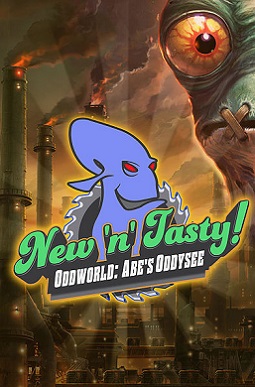
Oddworld: A tale of liberation and restoration

I played the original Oddworld: Abe’s Odyssey as a kid with my brother. I have fond memories of it–which is saying a lot, perhaps, given the game’s general grimness. In any event, I was happy that a remake was on the Nintendo Switch’s online store for me to buy!

Oddworld is a story of liberating slaves from their oppressors (viz., Sligs). A big idea is that faith is the Sligs’ enemy, and should be harnessed to the extent possible. To harness his power to the fullest, Abe has to visit ancient lands to acquire wisdom lost to most of his brothers.

I didn’t remember everything just as it happened in the original game. Specifically, I was awed by the Shrykull chant Abe gains after visiting both Paramonia and Scrabvania. The idea here is that animals were once regarded as sacred, but in the wake of pre-industrialization, they became viewed as raw material for tasty food.

This Oddworld story is about gaining animistic–“animystic”, anyone?–power to undo the moral wrongs of Abe’s society. These wrongs include desacralization of both animals (granted though they are monstrous) and individuals, the latter of whom are treated as slaves. I did receive the “bad ending”: I must have been just a few Mudokons short of having the good one, instead; but I still enjoyed revisiting a game with deeper meaning than I initially grasped, with poetry interspersed and potty humor to lighten the overall mood.

Subjective vs. objective belief

I shared a funny Onion article I found on Facebook some months ago. The article describes a fictional boy returning home after receiving his undergraduate philosophy degree. The boy remarks to his father that: “There is no rational justification for belief!” Today, this has gotten me thinking about a more subjective view of belief versus the one I engaged with as an undergrad in philosophy. In the latter, knowledge is equated with justified true belief (in mathematical form–K=JTB).

Certainly, K=JTB is the preferred formula for scientific belief. Empirical science relies on the shared sensory perception of data, and established analytic procedures to run it through. K=JTB seems a useful philosophical companion to this hypothetico-deductive approach to reaching knowledge*.

K=JTB clearly shows that–in order to attain knowledge–belief should be (rationally) justified. But it occurred to me that there are certain kinds of belief of the more subjective kind that cannot be plugged into K=JTB, yet are nonetheless indispensable. I am thinking particularly of religious knowledge, or more appropriately conviction. Intuitive knowing of this kind might seem risky at the outset, yet we are always operating under a certain degree of uncertainty. Conviction is what pushes us through such moments to make a decision and be open to its consequences.

And while experience might not be empirically falsifiable (though it can be dismissed), it may still be shared meaningfully between participants. Such individuals can trust their experience and share interpretations of it with the involved other; these interpretations can meld into a common understanding of what has taken place. Experience seems to demand subjective belief if we are to view the former as inherently meaningful.

*Of course, data science has its own hierarchy of knowledge, where data becomes information which becomes knowledge. Belief’s role is unclear here.

The Wild Area: A place of freedom and encounter?

As I type this, I sit atop a nearby Starbucks patio. Overlooking the streets and ocean, I am reminded of the freedom we had (in California) pre-pandemic. Things feel freer than they have in a very long time!

There are a handful of folks around me. Though we all sit in our respective islands, there seems to be a frank happiness. Our masks are off and we all enjoy sitting under the same sun.

This is by no means a Wild Area of the kind seen in the latest main series games, Pokémon Sword and Shield. And it certainly isn’t a frozen tundra the likes of which made up the landscape of their second DLC, Crown Tundra. There certainly is no snow falling for me on this calm, bright, and sunny day.

But I feel here a sense of wonder and openness as the Crown Tundra’s outdoor theme plays in my mind…the world feels magical, yet settled. There is a freedom here that a simple, consumerist cup of cappuccino has enabled! A vaguely familiar face to my left completes the picture of a gradual return to normalcy–albeit, a mindful one.

Life phrasin’

Estarto

“Necessary feelings, only.” I’m feeling the white-hot feeling of self-respect! We are all convenient conflators across a rich range of emotionality. Love torn in two is not a whole love (a hole has been shorn into it…). Chanda was impregnated into the womb of my mind by Mama~

He who is triggered–in the soft, weak, emotional sense (really, the only kind)–loses. Minimum perturbations can shatter him. Frustration, itself, is the dark side of passion.

Yet–we are embodied souls! Love makes all of our best-argued arguments invalid (hear that, Soundness?). Roll your love up into an everlasting burrito of Love–for Chanda! A real rajma burrito for din…

Breaking through the hubristic debris, I back down away from certain situations. These include lonely, social app down scrolls during the wee hours of night. Screens are unconscious, symbolic imprints engendered via the “pure” semiotic encounter. (They don’t mean anything; not inherently!)

Curse–nay, bless–my moderate psychological sensibilities!

She was just an emissary of the eternal feminine. I have been doing my relative best! With the yearning for adventure on my heart–Zoom panoplies; “texy tecthics” (whatever they may be, sexy text-tonics…?). 

Chromebook questions on that latter one, anyone? I am but a simple tutor, my liege! Ask away, m’ boi…

Psychological permissibility does not extend to the phenomenon of stress-gaming. What an odd-handed endeavor…that’s the soul? (No.) No need to bypass an adventure: not when my soul is so lit up with Spirit!

What to do with a COVID-locked trail of COVID following a probable non-offender? Let him go. Let him–as you would anyone a true, blue, hue-woe-manist would. 

Finito

Self-actualizing well-being

Self-actualization for Maslow consisted of 12-13 characteristics. These were:

  1. Superior perception of reality
  2. Increased acceptance of self, of others and of nature
  3. Increased spontaneity
  4. Increase in problem-centering
  5. Increased detachment and desire for privacy
  6. Increased autonomy, and resistance to enculturation
  7. Greater freshness of appreciation, and richness of emotional reaction
  8. Higher frequency of peak experiences
  9. Increased identification with the human species
  10. Changed (improved) interpersonal relations
  11. More democratic character structure
  12. Greatly increased creativeness
  13. Certain changes in the value system

PERMA well-being defined by Martin Seligman, Ph.D. consists of positive emotion, engagement, relationships, meaning, and achievement.

When we put the above two models together, we can learn to be well as we actualize. In an individualistic democracy, we can live spontaneously, taking solace in our independence and objectivity. We can focus on building meaningful and intimate relations with others (item #10) whom we accept as we do ourselves. We can achieve superior understandings of reality and solve important problems. We can reach the highest levels of rich, positive emotion (appreciation being one such state of being) through the elusive and mystical peak experience. We can engage in our own evolution as our values–and hence, our characters–change. And we can find meaning in creative endeavors that set our spirits free, igniting our souls with passion that leads us to our ultimate purpose.

Pokémon and prediction

In Season 3, Episode 24 of Pokémon the Series: Gold and Silver (“Wired for Battle!”), a top dojo student and Pokémon trainer battles protagonist Ash and loses. What the episode seems to impart is that experience tells the “real story” in a way that data analysis can’t. Ash’s competitor in this episode relies heavily on his database and predictive model for battling; Ash relies on his gut.

SPOILER:

Does Ash’s foe lose because his instincts are too poor? Is his machine learning lacking? Proper inference relies on the quality of both data and calculation using it. Perhaps the dojo fighter’s ML instincts (specifically, his “process”) need work!*

*I recognize this is not the central point of the episode: but, it still got into a data science mood… 🙂 As a former Pokémon simulator battler and user of many screens, this episode tugged me especially.

Hate in The Flash

In DC’s recent TV show The Flash, protagonist (and hero in disguise) Barry Allen struggles with feelings of hatred toward his main enemy. Eobard Thawne–A.K.A., the Reverse Flash–murders Barry’s mother, Nora, while Allen is just a kid. His father is wrongly accused for the crime, and is sent to prison for nearly the rest of his life.

Barry’s future daughter, also named Nora, wonders if her dad hates Thawne. However understandable The Flash’s feelings are toward his nemesis, though, he never acts on his hatred. This is in part what makes Barry (played by Grant Gustin) a hero: learning to regulate himself, despite his negative emotions.

Unbridled, enacted neuroticism could be anyone’s downfall; or even their kryptonite?! As my favorite book character, Bobby Pendragon once said: “It’s okay to think like a weenie, as long as you don’t act like one”…

Existentialism’s limit: relationality

One of existentialism’s givens is isolation (or alienation). Another is death; we are mortal beings who inevitably perish.

In a relational universe, how can it be that we are inherently alone? This fact would imply that we each die alone, also.

Yet we come into being–are thrown into the world–birthed through the love shared by two individuals. We ultimately die, following a path shared by every living being whose lives already ceased.

We are never truly alone, contra-modern existentialism.

How humanity saves the planet

Learned helplessness explains, more than psychological disorder, why those with high concern for the environment are not as engaged behaviorally. We learn helplessness when a problem feels too big, threatening, abstract–or remote. Abstractness correlates positively with psychological (spatial; temporal; experiential) distance.

When psychological distance is too great, our connection to things or people suffers. When we are disconnected from a situation, it holds no sway over our actions: we feel no will to improve it. The problem persists, and we lose the game.

How do we close psycho-environmental distance? Make a situation’s proximal features apparent. Show people how a global problem is local–perhaps even in their own cities. (Obviously, don’t create problems unnecessarily!)

The above is only one path to solving (e.g.) global climate change. Psychological distance can be bridged by appealing to people’s identities, foremost. These include their political values: liberals tend to show more innate concern for the environment; conservatives are moved more by appeals to, for example, purity.

Social identity is also important: when people feel part of a global collective, they are motivated to get pro environmental. Understanding the cultural psychology of motivation and behavior (conation) facilitates global sustainability. The world’s psychological diversity can then be leveraged to solve environmental problems, like climate change (or pre-societal coronavirus). Appealing to global social identification, pro-sociality (via viral altruism, e.g. social media sharing of good deeds), and distinct political values will help us understand the diverse cultural psychology necessary to leverage.

What does the “psychological diversity” just mentioned consist of? It consists of individualistic and collectivistic sociocultures, along with personality factors. Individualistic individuals are motivated more by personal belief, while collectivists are moved by social influence. Pro-environmental behavior correlates positively with the personality factors Conscientiousness, Extraversion, and Openness (e.g., appreciation of aesthetics–i.e., that of nature).

We know–further–that values, beliefs, and “norms” are important for motivating pro-environmentalism. When people believe that their values are threatened, they become more likely to defend what they cherish. For many of us, this is the natural environment.

I’ve performed case studies of important environmentalists in Rachel Carson, Al Gore, Greta Thunberg, Wangari Maathai, and Chico Mendes. By focusing on how they have led their lives in inspiring and self-actualizing ways, I determined what made–and, in Al and Greta’s cases, makes–them unique leaders. My efforts fill a gap in environmental psychology, but this is not the only gap that exists. It will be up to us moving forward to uncover the specific links between the actions taken by an exemplary few with the global plan to preserve the natural environment.

It is up to all of us to do this!